

On paper, the Philippines is one of the friendlier places to ship swag: parcels under ₱10,000 clear duty-free. Then your thirty onboarding kits land in Manila on the same day, customs adds them up as one consignment, and the friendliness ends. The reliable way to get swag to your Philippine team is to make it in the Philippines. And our order data has strong opinions about what to make: hoodies. Yes, in the tropics.
Key takeaways
- The ₱10,000 duty-free threshold (about US$170) looks generous, but customs aggregates same-day shipments to the same recipient. A batch of employee kits gets assessed as one taxable import.
- Local production means domestic delivery in days, no threshold math, and no clearance queue before the island last-mile even starts.
- Hoodies are the standout in our Philippine order data, at 27% of units versus 17% globally. Air-conditioning beats the weather report.
Why importing swag into the Philippines hurts
The Customs Modernization and Tariff Act gives the Philippines a real de minimis: shipments valued at ₱10,000 or less enter free of duty and tax. A single t-shirt in a mailer will usually slip under it. That’s the good news, and it’s also where the good news stops.
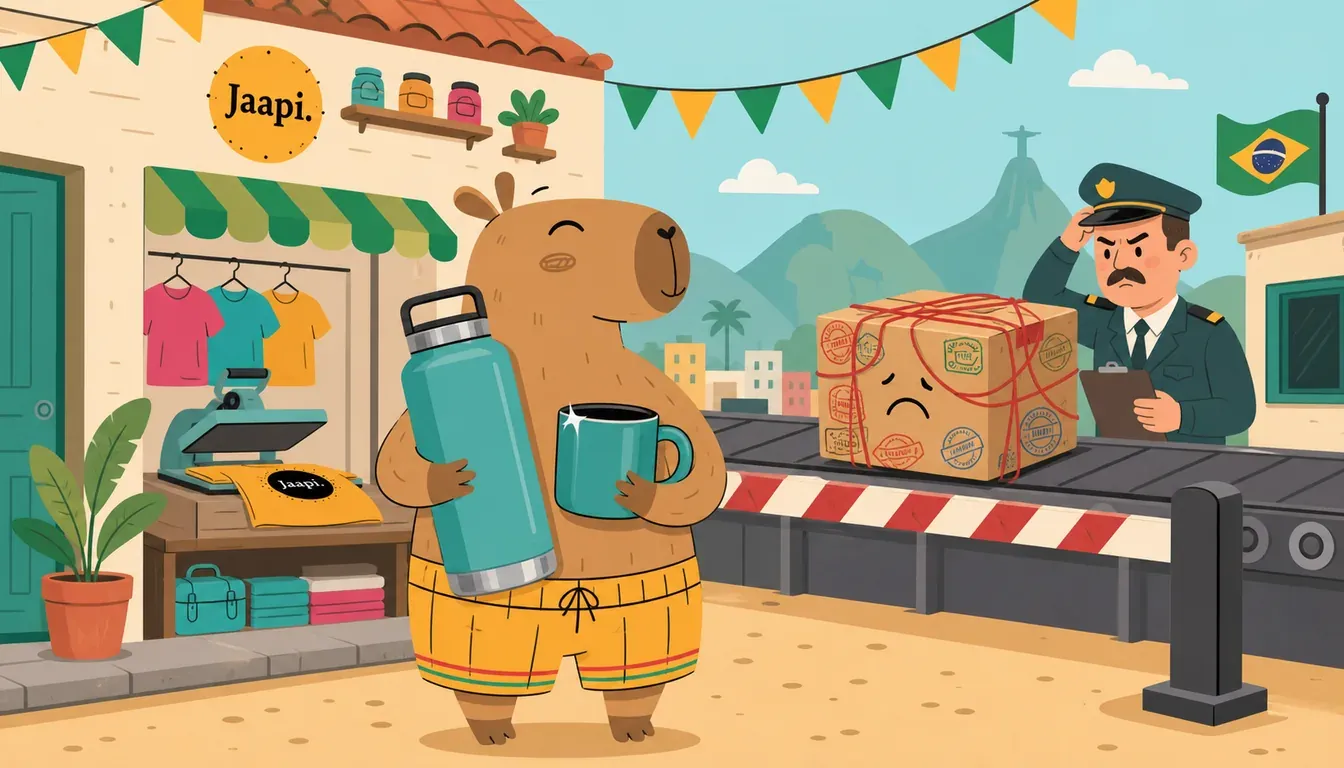
The catch is aggregation. The Bureau of Customs treats multiple same-day packages to the same recipient and address as one consignment, precisely to stop people from slicing a big shipment into duty-free crumbs. A swag drop for a 40-person office in Taguig is exactly that pattern. Once the total crosses the threshold, you owe duty on the goods plus shipping, then 12% VAT calculated on the duty-inclusive amount, plus whatever clearance and processing fees the express carrier tacks on.
Clearance time is the quieter cost. A parcel from abroad does all of its waiting in one customs queue in Manila before domestic delivery across an archipelago of thousands of islands even begins. When a box misses an onboarding date, this queue is usually why.
For the rare item that truly has to cross the border, ship it DDP so the recipient never gets a bill; we broke down DDP vs DDU in an earlier post. DDP moves the cost onto you, though. It doesn’t remove it.
Make it in the Philippines instead
Jaapi produces locally in the Philippines, with a facility covering DTF and UV printing. When someone in Quezon City orders a hoodie, it’s printed in the Philippines and delivered domestically, typically within 4 to 8 business days. Nothing crosses a border, so there’s no threshold to calculate, no aggregation surprise, and no customs queue. Domestic carriers handle the island last-mile every day; the difference is your swag starts there instead of behind a clearance desk.
There’s no warehouse either. Items are produced when someone orders them, so there’s no bulk shipment to clear and no box of leftover sizes in a Makati storage room.
What Philippines-based employees actually order
We pulled every paid order our stores have shipped to the Philippines and compared the mix against the rest of the world. Assortments differ from store to store, but the pattern is consistent:
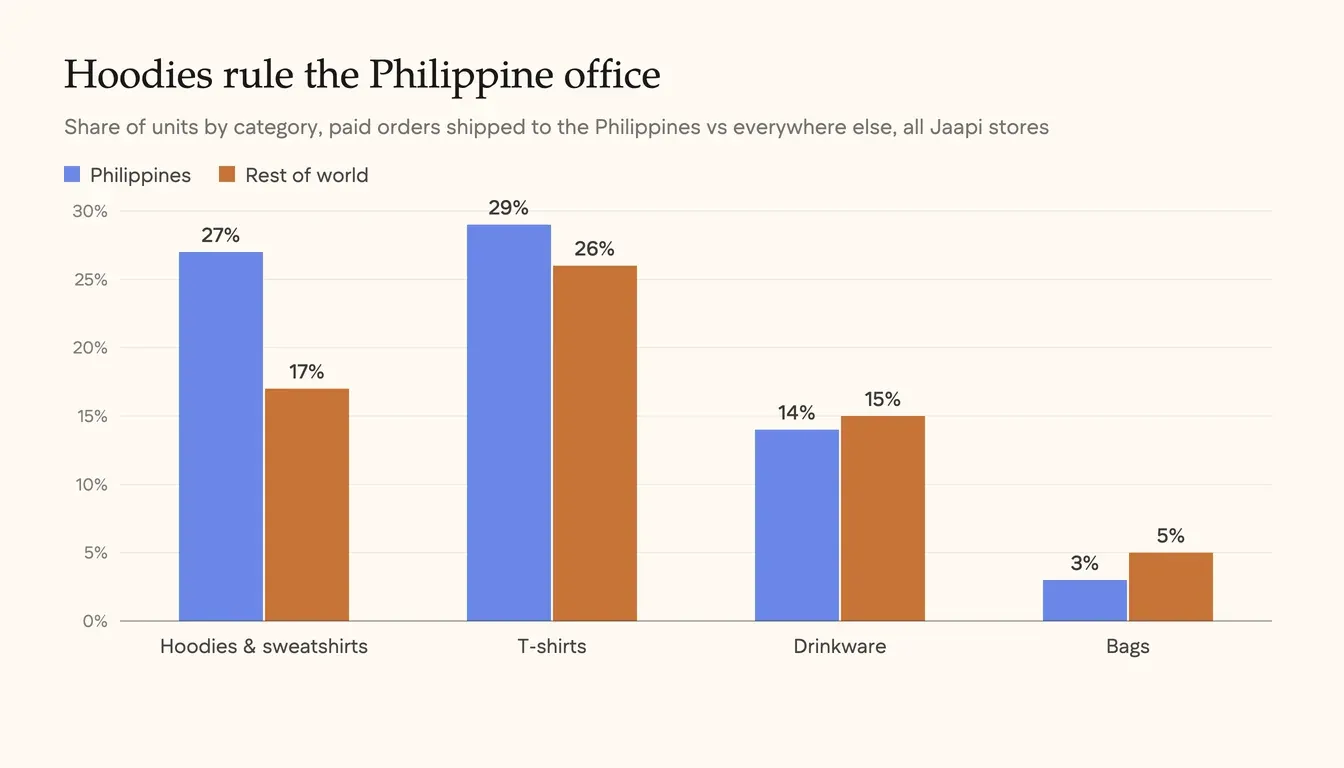
- Hoodies over-index by half again their global share, in a country where the daytime forecast reads 31°C every single day. The explanation sits in our city data: the orders cluster in Metro Manila, led by Quezon City, Taguig, Makati, Pasig, and Mandaluyong, which is office country. Philippine office air-conditioning is legendary, and the hoodie is the survival gear.
- T-shirts hold their global share. No surprises, and no over-index either. The tee is the baseline everywhere.
- Drinkware sits exactly at the global average. India doubles its drinkware share; the Philippines doesn’t. Assuming “hot country, must want bottles” would have missed on both counts.
- Bags under-index at about half the global share, so a backpack-first kit is a mainland guess that doesn’t travel.
The bigger lesson is to stop guessing entirely. With a swag store, your Philippine team picks what they actually want, in their size, from items produced in their region. The hoodie insight came from employees choosing, not from a merchandising meeting.
One timing note: the ber months
Christmas in the Philippines starts on September 1st, when the radio switches to carols and the parol lanterns go up. It’s the longest holiday season anywhere, and it peaks with 13th-month pay and year-end parties in December. Local production keeps lead times in days rather than weeks, but the facility gets busy as the season builds. Set up your holiday gift campaign in October, not mid-December.
How Jaapi handles the Philippines
Your store shows each employee only the items that can be produced in their region, so nobody in Cebu orders something that would need to be imported. Orders route to local production, get made on demand, and ship domestically with tracking across the islands. Your team in the Philippines gets the same brand, the same quality, and a delivery that never met a customs officer.
Book a demo to see it working, or check where we produce locally.