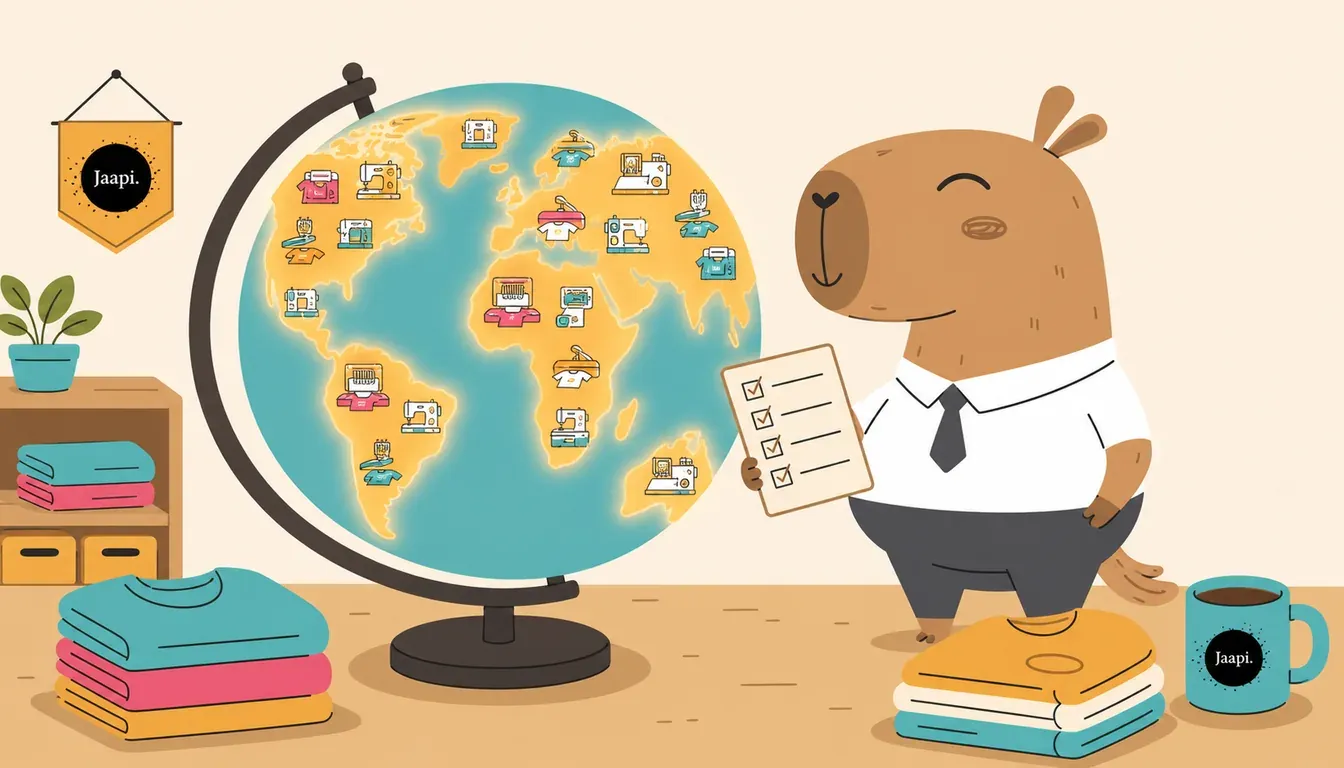

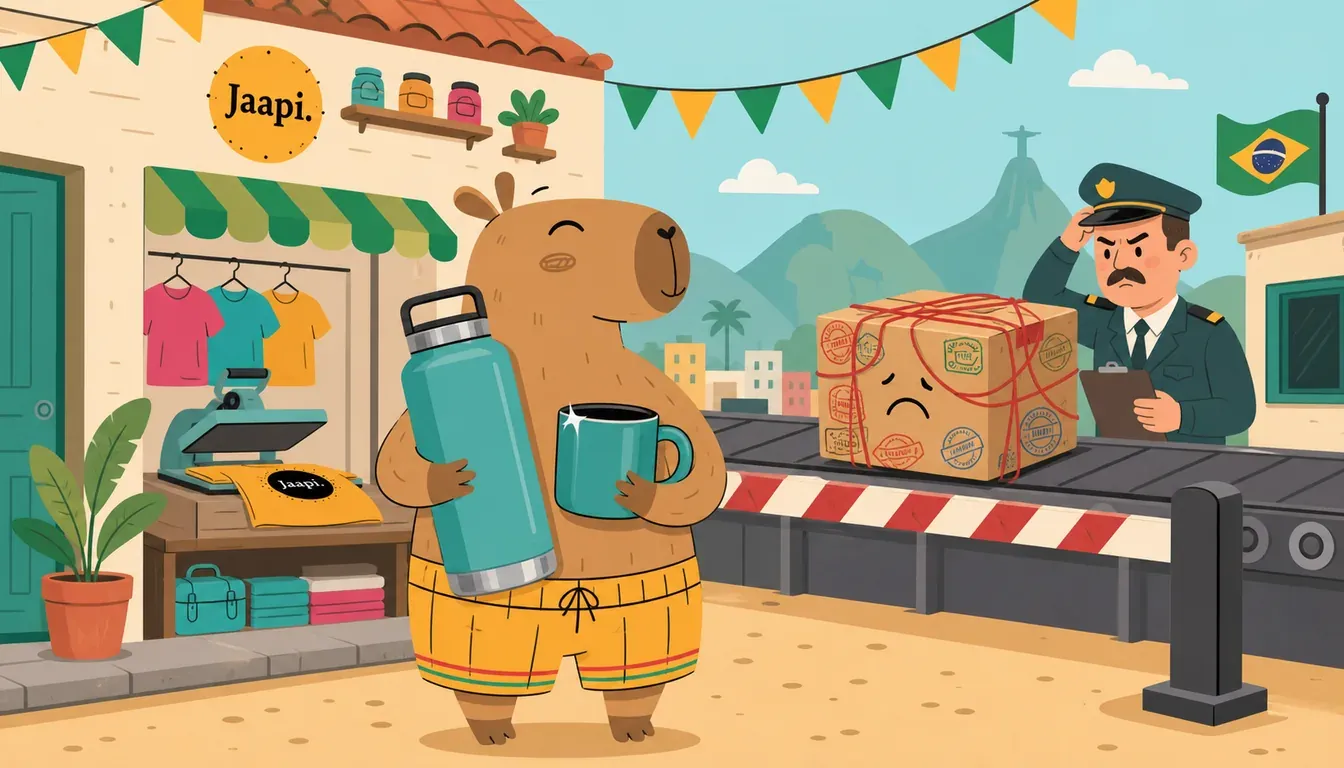
Our mascot is a capybara, and capybaras are from Brazil. It would be a little embarrassing, then, if our answer for getting swag to your São Paulo team involved a container ship and a customs broker. It doesn’t. You don’t ship swag to Brazil. You make it in Brazil.
Key takeaways
- Brazil taxes corporate shipments at 60% of the item’s value plus shipping, then adds state tax on top of that. The taxes on an imported hoodie can cost more than the hoodie.
- Every inbound parcel needs the recipient’s tax ID before it clears customs. Local production skips the border entirely, with domestic delivery in 4 to 8 business days.
- Our order data says Brazil-based employees pick steel bottles and mugs at roughly one and a half times the global rate. Almost nobody picks a polo.
Why importing swag into Brazil hurts
You may have read about Brazil’s on-again, off-again tax on small parcels. The “taxa das blusinhas” put a 20% tax on purchases under US$50 in 2024, and a provisional measure made them exempt again in May 2026. None of that helps you. The tug-of-war covers consumer purchases on registered e-commerce platforms. A company sending merch to its own people plays by the older, blunter rule: a 60% import duty, assessed on the item’s value plus shipping and insurance.
Then comes ICMS, the state tax, charged on the duty-inclusive total. Run the numbers on a $40 hoodie with $30 of international shipping: duty is 60% of the full $70, so $42, and ICMS adds roughly $20 more on the pile. The tax bill beats the price of the hoodie.
The paperwork is its own obstacle. Brazilian customs will not release a parcel without the recipient’s CPF, or a CNPJ for companies, so every single employee has to hand over their tax ID before their gift can move. A missing or mistyped number means the box sits in a bonded warehouse while emails fly. We know how specific Brazilian delivery is because our checkout already collects the fields local carriers expect, including the bairro line that most address forms have never heard of.
If something genuinely must cross the border, ship it DDP so the recipient never sees the bill; we wrote a whole post on DDP vs DDU. But DDP only moves the 60% onto your budget. It doesn’t shrink it.
Make it in Brazil instead
Jaapi runs two production facilities in Brazil covering embroidery, DTF, and UV printing. When someone in Campinas orders a bottle, it’s made in Brazil and delivered domestically, typically within 4 to 8 business days. No duty, no CPF chase, no bonded warehouse. Shipping costs a few dollars instead of the $50+ an international express label runs before the taxman even wakes up.
There’s also no warehouse in this model. Items are produced when someone orders them, so there’s no bulk shipment to clear customs and no carton of leftover size M gathering dust in the Rio office.
What Brazil-based employees actually order
We pulled every paid order our stores have shipped to Brazil and compared the mix against the rest of the world. Assortments differ from store to store, but the pattern is consistent:
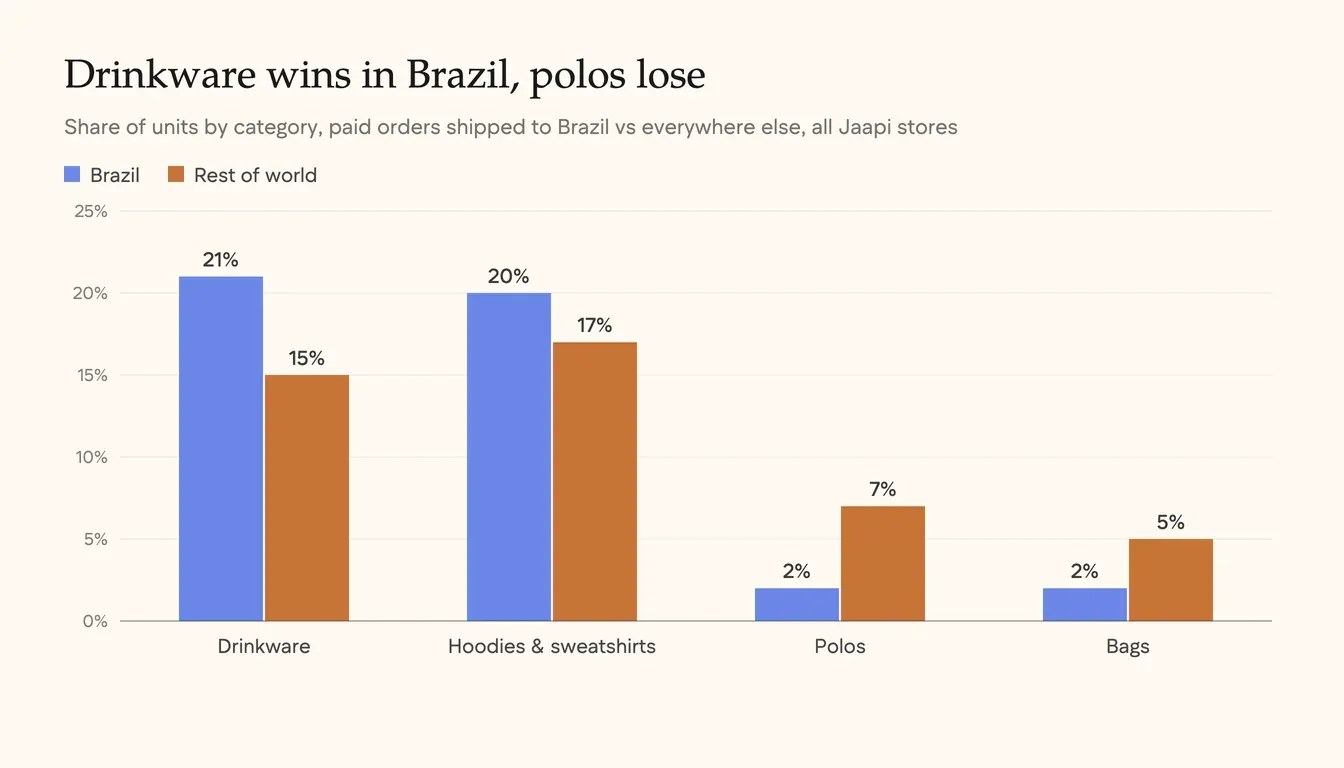
- Steel bottles and mugs are the top pick, at roughly one and a half times their global share. The gap gets wider, not narrower, when we exclude our largest Brazilian store, so this is a Brazil thing rather than one company’s taste.
- Polos barely register. They take about a third of their usual global share. A polo looks like the obvious choice for a warm country, and the order data politely disagrees. If your Brazil kit is built around polos, you’re sending what’s easy to guess, not what gets worn.
- Bags under-index too, at about half their global share. That one surprised us, since laptop backpacks are the runaway favorite in India.
- Hoodies run slightly above the global share. Look at where the orders go and it stops being strange: after São Paulo and Rio, our biggest Brazilian cities are Curitiba, Florianópolis, and Porto Alegre. The south of Brazil owns actual winters.
The bigger lesson is to stop guessing entirely. With a swag store, your Brazil team picks what they actually want, in their size, from items produced in their region. The mix question answers itself.
One timing note: amigo secreto
Brazilian offices take their year-end seriously. December means festas de fim de ano and the amigo secreto gift exchange, and remember that Christmas lands in high summer there, so nobody wants a beanie in a heatwave. Local production keeps lead times in days, but the facilities get busy in November and December. Set up your year-end campaign a few weeks ahead, not the week of.
How Jaapi handles Brazil
Your store shows each employee only the items that can be produced in their region, so nobody in Belo Horizonte orders something that would need to be imported. Checkout collects the CNPJ and bairro fields Brazilian carriers require, orders route to a local facility, and everything ships domestically with tracking. Your team in Brazil gets the same brand and quality as headquarters, minus the customs drama.
Book a demo to see it working, or check where we produce locally.