


Ask three people what Canada’s duty-free threshold is and you can get three correct answers: $20, $40, or $150, depending on how the parcel travels and where it ships from. A hoodie blows past all three anyway. The dependable way to get swag to your Canadian team skips the question entirely: make it in Canada.
Key takeaways
- Canada’s de minimis is a maze: CAD $20 for postal shipments from anywhere, and only courier shipments from the US or Mexico get the friendlier CAD $40 tax-free and $150 duty-free lines. Typical swag clears none of them.
- Above the thresholds you pay duty, provincial tax that ranges from 5% to 15%, and the courier’s brokerage fee for doing the paperwork.
- Our order data says swag has seasons in Canada: warm layers jump from a fifth of orders in summer to a third in the cold months, a swing twice as large as anywhere else.
Why importing swag into Canada hurts
Start with the thresholds. Ship by post from any country and the duty-free limit is CAD $20, a number set when a hoodie cost less than a movie ticket. Courier shipments get better treatment only if they come from the US or Mexico: no tax under CAD $40, no duty under CAD $150. Anything else, including that bulk order from an overseas printer, plays by the $20 rule. Since most swag items land above these numbers, the thresholds mostly decide how the pain is calculated, not whether it happens.
Then the bill assembles itself in layers. Duty depends on the product classification. Sales tax depends on the destination province, anywhere from 5% GST in Alberta to 15% HST in the Atlantic provinces, so the identical gift costs your Halifax teammate’s budget more than your Calgary one’s. And the courier adds a brokerage fee for walking the parcel through customs, plus a disbursement charge for fronting the taxes. On a $30 gift, the fees can outweigh the taxes they process.
One more wrinkle arrived in 2025: the classic workaround of staging Canadian swag in a US warehouse got worse, because the US suspended its own de minimis exemption. Now that inventory pays duty twice, once entering the US and again entering Canada. If a shipment truly must cross the border, send it DDP so the recipient never sees the bill; we wrote up DDP vs DDU separately. DDP relocates the fees onto your invoice. It doesn’t shrink them.
Make it in Canada instead
Jaapi runs two production facilities in Canada with our full decoration lineup: embroidery, DTF, DTG, laser engraving, sublimation, and UV printing. An order from Vancouver gets made in Canada and delivered domestically, typically in 4 to 8 business days, with no customs entry, no brokerage line, and no provincial tax surprise at the door. Our Canadian orders run coast to coast, with Toronto, Vancouver, Calgary, Ottawa, and Montréal leading.
There’s no warehouse in the model either. Items are produced when someone orders them, so no carton of size M sits in Mississauga waiting for a duty bill.
What Canada-based employees actually order
We pulled every paid order our stores have shipped to Canada and compared the mix against the rest of the world. Assortments differ from store to store, but the pattern is consistent:
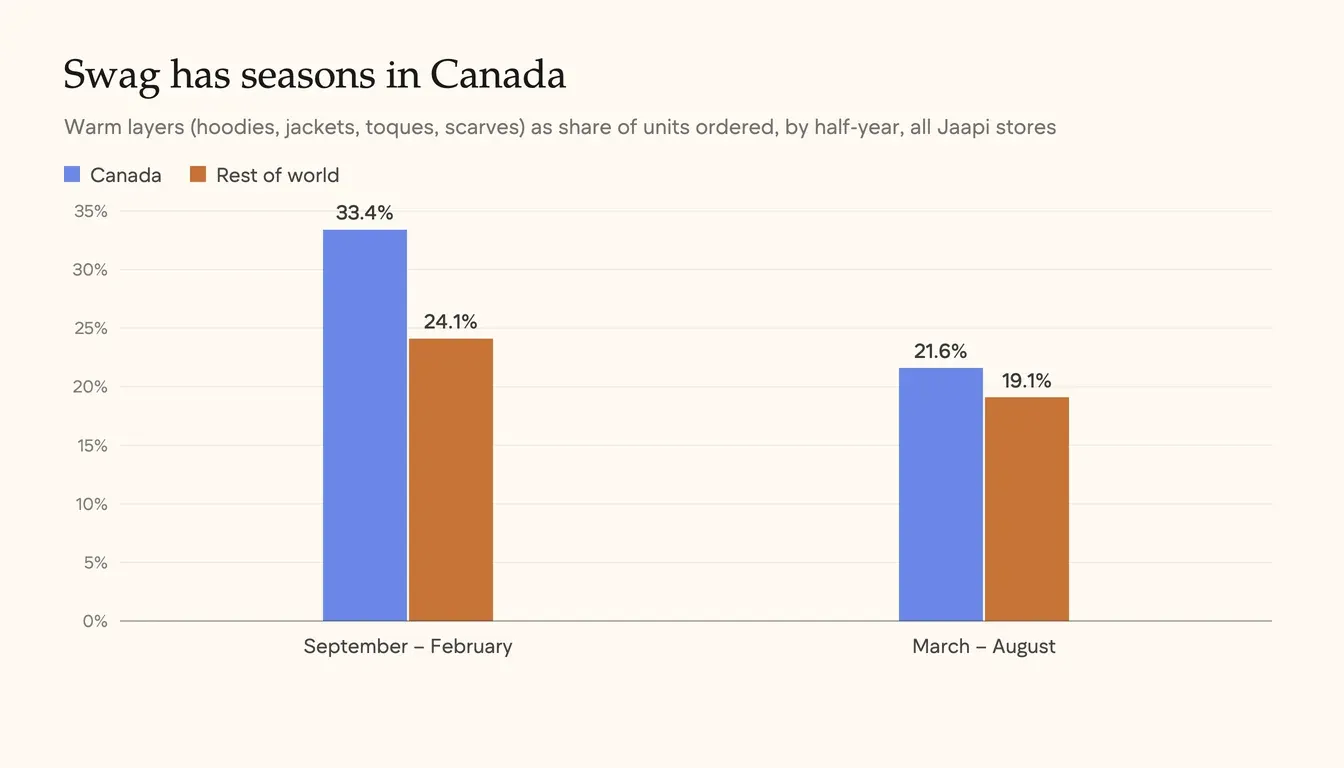
- Swag has seasons in Canada. In the September-to-February half of the year, hoodies, jackets, toques, and other warm layers take a full third of Canadian orders, up from about a fifth in summer. That twelve-point swing is more than double what the rest of the world shows, and the global number is inflated by holiday gifting to begin with.
- Hoodies run well above the global share all year, at about a fifth of everything ordered, and the pattern holds across more than a dozen stores.
- Toques punch above their weight. Knit beanies take about one and a half times their global share, which is the least surprising sentence in this series.
- Polos and ballcaps under-index. Both take roughly two thirds of their usual share; collars and sun brims lose to warmth. Drinkware sits slightly below the global average too, which genuinely surprised us for a coffee-drinking country.
The bigger lesson is to stop guessing entirely. With a swag store, your Canadian team picks what they actually want, in their size, from items produced in their country. The seasonal swing takes care of itself when people choose in real time.
One timing note: think September, not December
The data above has a practical edge: Canadian warm-layer demand wakes up in September, well before the holiday rush. If you launch your winter gift drop in early fall, your team gets their hoodies while the season is still on, and you skip the December production crunch entirely. A second, smaller wave in the new year catches the January-hire onboarding kits.
How Jaapi handles Canada
Your store shows each employee only the items that can be produced in their region, orders route to a Canadian facility, and delivery is domestic with tracking. Nobody calculates which of three thresholds applies, and nobody pays a brokerage fee on a beanie.
Book a demo to see it working, or check where we produce locally.