


Picture this: You have found the perfect corporate gift for an international client, or you are ready to send that welcome kit to an employee. But instead of thanks, they receive a demand for payment before they can claim their “gift.” Ouch. A gift sent DDU (Delivered Duty Unpaid) is essentially a bill disguised as a present. Your recipient has to wrestle with a confusing courier website and pay fees they never expected.
Below is what DDP and DDU actually mean, why customs is messier than either acronym suggests, and how to make sure your gift arrives as a gift, not a bill. (Hint: there is also an even better way.)
Key takeaways
- With DDP the recipient just gets their gift. With DDU they get a customs bill, and the goodwill you lose costs more than the shipping you save.
- Customs is unpredictable. Documentation requirements vary by country, and even perfect paperwork doesn’t guarantee smooth delivery.
- Local production sidesteps the whole problem: items are made near the recipient, so there are no customs fees to pay and no paperwork to get wrong.
Understanding DDP and DDU shipping terms
DDP (Delivered Duty Paid) means you, the sender, cover everything: shipping costs, customs duties, and taxes, all paid before the package even reaches its destination. You absorb the charges at checkout, the carrier bills your account directly, and the package sails through customs without your recipient lifting a finger.
DDU (Delivered Duty Unpaid), often labeled DAP (Delivered at Place) in modern shipping systems, places all the customs fees, taxes, and random handling charges on your recipient when the package reaches their country. The carrier essentially presents them with an invoice for import duties.
These shipping terms fall under Incoterms, the internationally recognized trade rules that dictate who is responsible for what during shipping. In practice, the difference is night and day.
With DDP, your recipient simply receives their gift. No hurdles, no surprise costs, and no headaches. With DDU, that package remains detained at customs until your recipient pays the required fees. Legally, customs will not release it until someone settles the debt.
Yes, services like EasyShip or ShipStation can help manage DDP payments (though billing methods vary). But the fundamental question remains: who do you want handling this situation, your team or the person you are trying to impress?
DDP works, but not always, and it’s expensive
Every international shipment crosses borders where customs officials essentially play “What is in the box?” and then decide what taxes to charge based on local rules. Documentation requirements are a nightmare patchwork: some countries demand specific IDs, like CPF/CNPJ for Brazil, RFC for Mexico, or DNI for Colombia. Without that country-specific recipient information, your package might as well be on vacation at a customs warehouse.
To complicate matters further, customs agents have serious discretion in how they classify items. That branded notebook you sent might be “stationery” one month and “promotional material” the next, with completely different duty rates. Beyond classification issues, couriers often add their own administrative “brokerage fees” for processing paperwork.
International shipping is like weather forecasting — sometimes accurate, often not. A process that worked perfectly once may completely fall apart the next time, even when you replicate every single detail. Your paperwork can be in order, your HS codes correct, and some random country-specific regulation will still throw a wrench in the works.
And to be clear: even with DDP, there is no absolute guarantee of smooth delivery. The international logistics system is too complex for certainties. Some countries do not even offer DDP as an option. What looks clean on paper often hits messy realities at border crossings.
Finally, even when DDP works, you are still paying the customs and taxes. You are just doing it up front. It’s not uncommon that customs, taxes, and shipping together cost 2–4x more than the actual contents of the box.
How to ship with DDP (customs and taxes paid in advance)
If you want to avoid surprises as much as humanly possible, DDP is the route to go. So how do you actually ship with DDP?
If you are in the US or UK, the simplest way I have found is to register an account with ShipStation or EasyShip. If you are in Europe, I would recommend Sendify.
When you have opened your account and put in the recipient details, you are shown shipping prices across multiple carriers like UPS, FedEx, and DHL. Note that these prices are without DDP. To get the DDP option you usually have to toggle it on or add it as an additional service.
When shipping with DDP you must carefully describe what you are shipping, in what quantities, and at what cost in your local currency. You will also need the HS code for each item. HS codes come from the Harmonized System, an international standard for classifying goods, and my honest recommendation is to let ChatGPT or Claude help you figure them out. Lastly, you have to know what information customs in the recipient country requires. Shipping DDP to Mexico, for example, requires the recipient’s RFC number. Once you’ve filled out everything and paid for the shipment, the details are transferred electronically and you just print and attach your shipping label.
There is a better way (with price comparison)

Jaapi produces and ships swag and gifts locally, near where your employees or clients are, so you avoid international shipping, customs, and duties altogether. Many of our clients cut their global swag cost by a third. It’s also more sustainable, and domestic delivery is always faster than international.
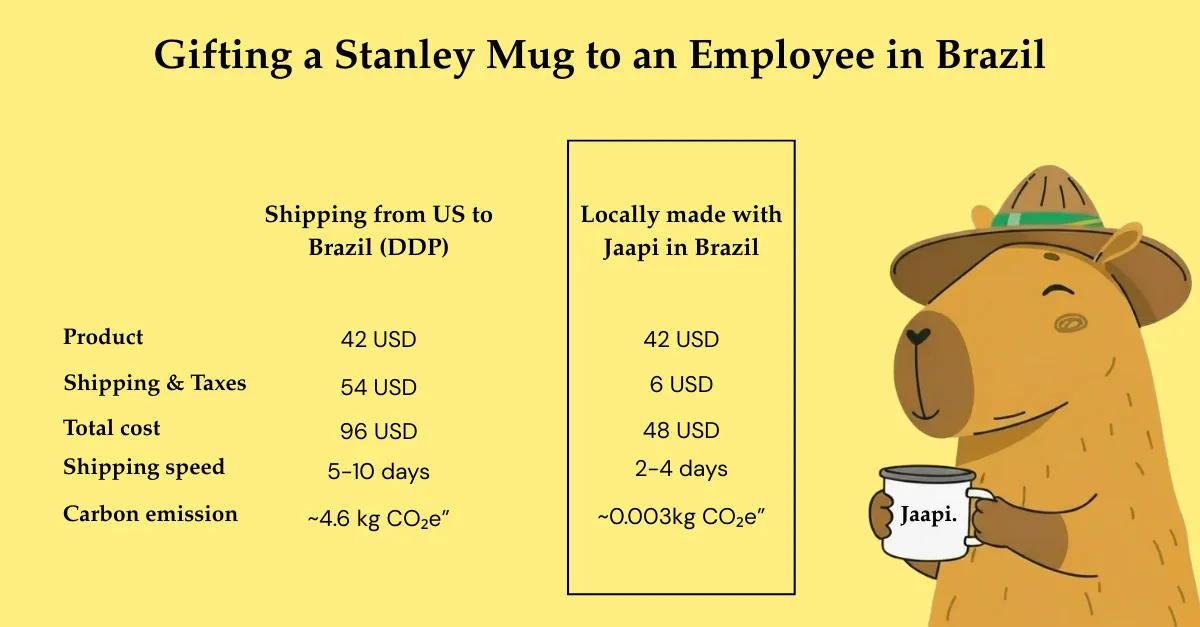
Book a demo to see how local production saves you money and improves the recipient experience at the same time. You can also check where we produce locally.