

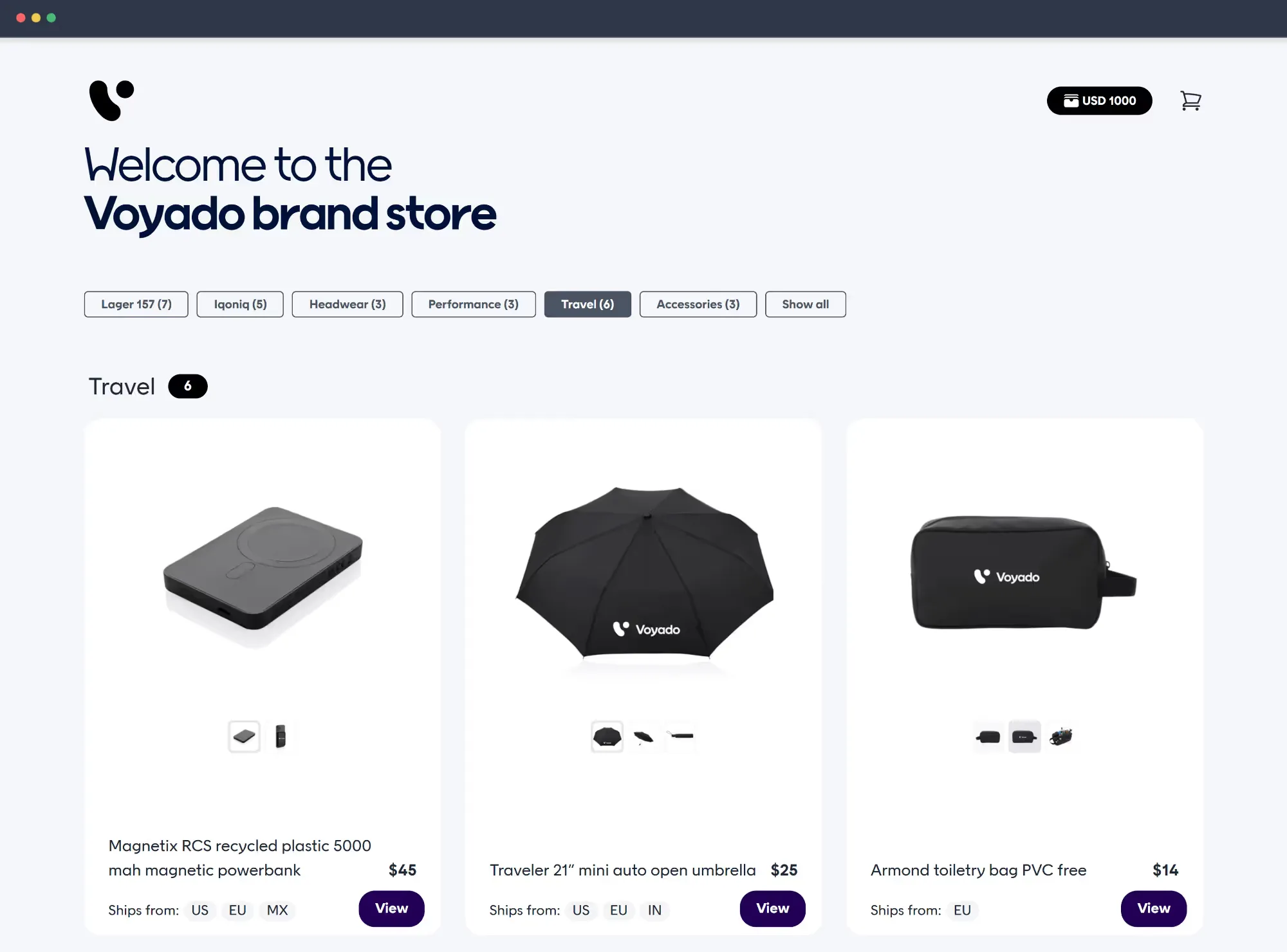
An employee swag store is an online store where your team orders branded merch themselves. It replaces the spreadsheet of sizes, the address collection, and the tracking-number forwarding that anyone who has managed swag manually knows too well.
If you’re the person responsible for swag at your company, this post covers the five ways a store makes that job smaller.
What is an employee swag store?
An employee swag store is an online platform where companies offer branded merchandise and apparel to their team: t-shirts, hats, jackets, tech gadgets, office accessories. The store carries the company’s branding and employees access it with their own login.
1. Streamline Your Merchandise and Designs
When every department orders swag from its own vendor, the result is five shades of your brand color across five qualities of t-shirt. Centralizing purchases in one place keeps branding consistent, usually costs less, and gives you one catalog to maintain instead of five vendor relationships.
The store becomes your company’s online wardrobe: every approved design and product in one place.
2. Empower Employees to Manage Preferences and Shipping Logistics
Collecting each employee’s size, preferences, and home address is tedious for you and mildly invasive for them. In a store, employees enter their own details and pick their own items. You never touch a spreadsheet again, and people end up with things they chose themselves, which is the single best predictor of whether swag actually gets worn.
3. Automated Shipping and Tracking for a Stress-Free Experience
Shipping logistics are the worst part of manual swag management. A store processes shipments automatically and sends tracking details to the recipient, not to you. When someone asks “where’s my hoodie?”, the answer is already in their inbox.
4. Embrace Print-on-Demand Swag Stores for Cost Savings and Sustainability
With print-on-demand, items are produced when someone orders them. No bulk order, no storage fees, no box of leftover mediums after everyone turned out to be a large. Nothing is produced that nobody wants, which does more for your environmental footprint than any material choice. Many on-demand catalogs also carry organic cotton and recycled options if you want both.
On-demand also changes what you can offer. Exclusive designs for a single event. A test run of a new design without committing to 500 units. Seasonal items that rotate. When quantity is not a commitment, experimenting is cheap.
5. Leverage Gifting and Credit Systems for Efficient Swag Management
Most swag stores support gifting and credits. Gifts fit milestones: work anniversaries, promotions, a strong quarter. Credits put a budget directly in each employee’s hands to spend how they like.
Credits also solve the fairness problem. Everyone gets the same budget, spends it on what they want, and you can see exactly where the swag budget went.
Conclusion
A swag store is not a culture strategy by itself. What it does is remove the logistics that made swag a chore: collecting sizes, forwarding tracking numbers, storing boxes of guesses. What’s left is the good part, handing people something with your logo on it that they actually chose to own.