

The US used to be the easy one. With an $800 de minimis threshold, the most generous in the world, you could mail a swag parcel from nearly anywhere and customs would wave it through. That threshold has been suspended for every country since August 29, 2025, and in June 2026 the suspension became indefinite. So the old playbook is dead, and the better plan was hiding in plain sight: make the swag in America.
Key takeaways
- The $800 duty-free exemption is gone for all origins. Every parcel entering the US now owes duty and requires a customs entry, no matter how small it is.
- Producing domestically means no entry filings, no origin-country tariff roulette, and delivery in days from four US facilities.
- Our order data says Americans pick polo shirts at two and a half times the global rate. Stationery doubles too. The plain tee, of all things, underperforms.
Why importing swag into the US hurts now
For a decade, cheap swag flowed into the US on the de minimis exemption: any shipment under $800 entered duty-free with almost no paperwork. That’s what ended in August 2025, first for China, then for everyone. Customs made the suspension indefinite in June 2026, so waiting it out isn’t a strategy.
What replaced it is the full grown-up import process, shrunk down to fit a padded mailer. Every shipment needs an informal or formal customs entry. Duty is assessed by product classification and country of origin, and in the current tariff environment that rate changes faster than any blog post can track. On top of the duty itself, carriers charge brokerage and disbursement fees per entry, which hurt most on exactly the small shipments that used to be free.
The bulk route took the same hit. Ordering five hundred hoodies from an overseas printer used to mean one cheap container ride; now it means duty on the whole consignment, formal entry paperwork, and a landed cost you can’t predict at order time. If a shipment genuinely must cross the border, send it DDP so your recipient never sees the bill; we covered the mechanics in DDP vs DDU. DDP moves the surprise onto your invoice. It doesn’t shrink it.
Make it in the US instead
Jaapi runs four production facilities in the US, our deepest bench anywhere: embroidery, DTF, DTG, laser engraving, sublimation, and UV printing. When someone in Denver orders a tumbler, it’s decorated domestically, routed to the nearest facility, and delivered in days with tracking. No entry, no duty, no brokerage line item. We’ve delivered to all 50 states, DC, and Puerto Rico this way.
There’s no warehouse either. Items are produced when someone orders them, so nothing sits in a storage unit depreciating in size Medium.
What US-based employees actually order
We pulled every paid order our stores have shipped to the US and compared the mix against the rest of the world. Assortments differ from store to store, but the pattern is consistent:
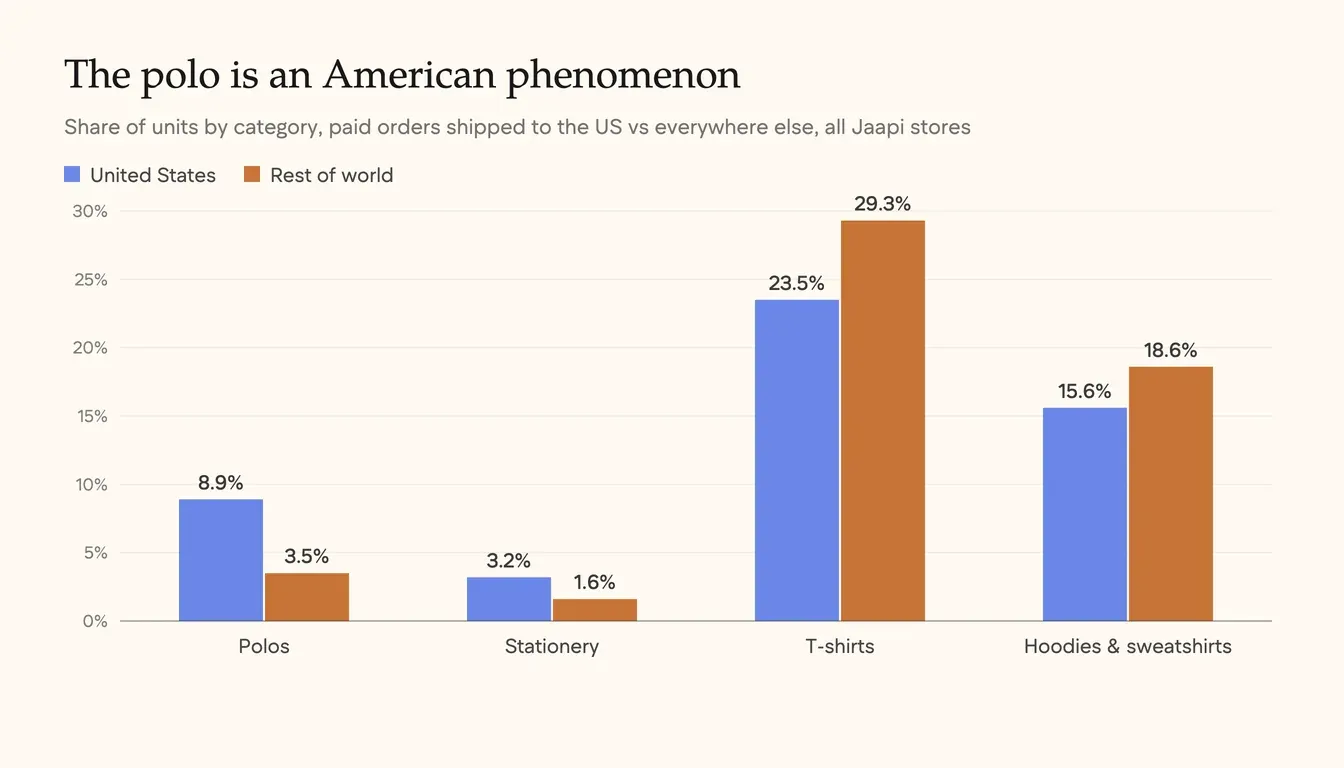
- The polo shirt is an American phenomenon. Polos take two and a half times the share of US orders that they do everywhere else, and the pattern holds across dozens of stores, so it isn’t one golf-happy company skewing the data. Client meetings, trade shows, and yes, golf outings all want a collar.
- Stationery doubles. Notebooks and laptop stickers take about twice their global share. Nowhere else do stickers work this hard.
- Plain tees underperform. They’re still a big category, but noticeably below their share in the rest of the world. American employees have seen enough free t-shirts; given a real choice, they pick something else.
- Hoodies run slightly below the global share, which surprised us until we saw what’s crowding them out: the US mix is the most eclectic of any region we ship to.
The bigger lesson is to stop guessing entirely. With a swag store, your US team picks what they actually want, in their size, from items produced in their country. The polo insight came from employees ordering, not from a brand survey.
One timing note: the Q4 crunch
American gifting concentrates hard between Thanksgiving and the holidays, and every facility feels it. Local production keeps lead times in days rather than the months a bulk import needs, but December capacity is finite. Set up your holiday campaign in early November and let people order while the calendar is still friendly.
How Jaapi handles the US
Your store shows each employee the items that can be produced in their region, and for the US that’s our widest assortment anywhere. Orders route to the nearest of four facilities, get made on demand, and ship domestically with tracking. Your team gets brand-name gear without anyone learning what a customs entry type is.
Book a demo to see it working, or check where we produce locally.