

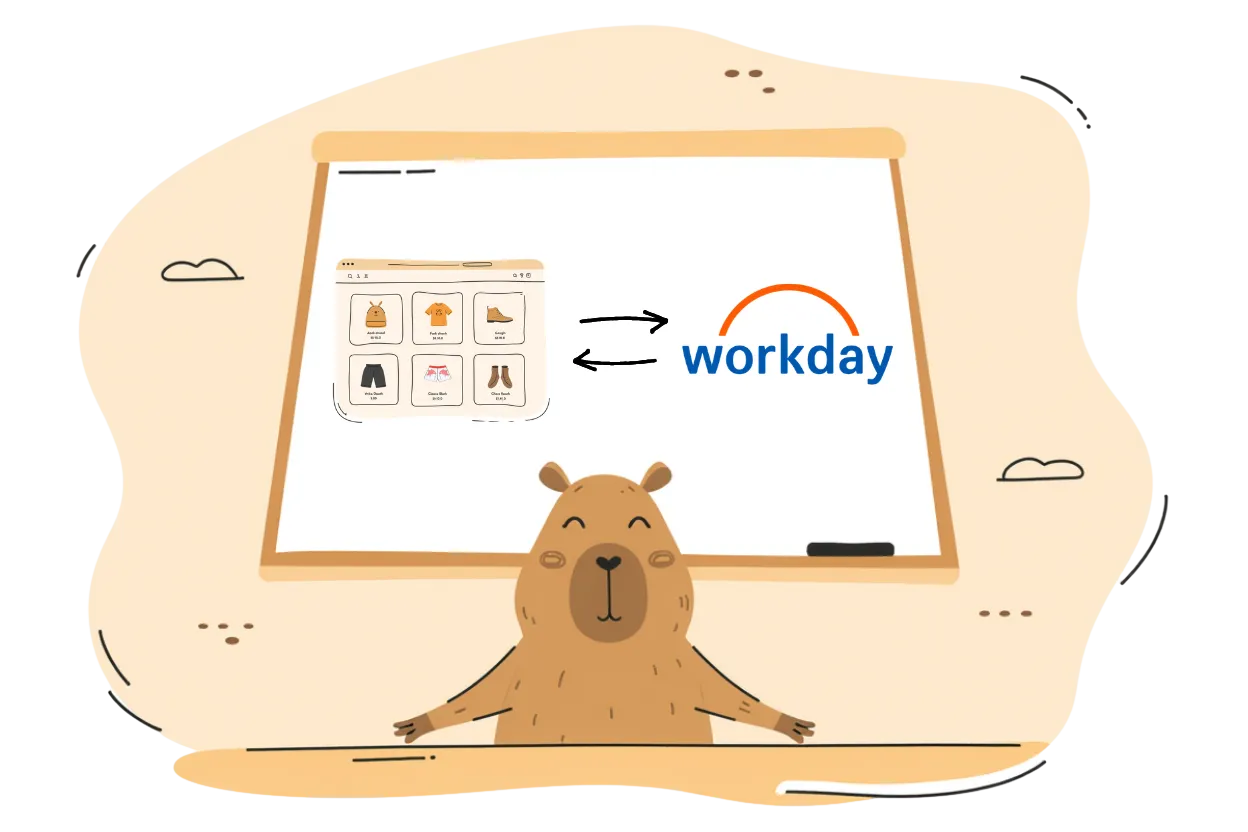
If you run a company swag store, there’s a quiet tax no one warns you about: somebody has to keep the user list in sync with HR. New hire on Monday? Someone creates their account. Contractor rotates off? Someone remembers to deactivate them. Monthly wellness credit? Someone exports a list, does the math, and pastes it in. Multiply that by a few hundred employees and a few countries and you end up with a part-time job nobody signed up for.
It doesn’t have to be that way. If your company uses a real HRIS (Workday, BambooHR, Rippling, Personio, HiBob, SAP SuccessFactors), the source of truth already exists. The only thing missing is a wire between it and your swag store. This article walks through what that wire looks like, why Workday is the most common example, and what “HRIS-driven swag automation” actually automates.
Key takeaways
- An HRIS integration turns your swag store’s user list into a downstream view of HR. Onboarding, offboarding, and credit allocation run off the daily sync instead of a person.
- The mechanism is simple: your HRIS exports a daily CSV of active employees and POSTs it to a Jaapi endpoint, which reconciles the list and distributes credit.
- Workday is the most common source (EIB outbound with REST delivery), but the same pattern works with any HRIS that can schedule an outbound export.
- SCIM handles identity provisioning but doesn’t carry HR context like budget tiers, hire date, or department, which is why a CSV-based sync is a better fit for swag automation.
The manual swag admin is a part-time job hiding in plain sight
Most swag programs start small. Fifty employees, a handful of admins, a Google Sheet. At that size, managing users by hand is fine: a bit tedious, but fine.
What kills the approach is growth. Once you’re past a few hundred employees, or once you operate in multiple countries, the admin overhead compounds:
- Onboarding lag. New hires are excited about swag in their first week. If provisioning their account takes five business days, you’ve missed the moment.
- Offboarding debt. Deactivating leavers is a security and budget issue. Forget to do it and departed employees can still place orders and drain credit.
- Credit distribution. Monthly credit top-ups, anniversary gifts, new-hire welcome kits — each one means an export, a calculation, and a bulk upload. Done quarterly at best, late every time.
- Reporting. Who got what, when, and why? Without a source of truth, the answer lives in email threads.
None of this is hard. It’s just repetitive, and repetitive work in a SaaS tool is the definition of a task that should be automated.
What an HRIS integration does for a swag store
The integration has one job: keep the swag store’s user list consistent with HR, and optionally let HR data drive credit distribution.
Concretely, a daily sync handles three workflows:
Onboarding. Any employee who appears in today’s HRIS export but doesn’t yet have a store account gets one created. If you have a welcome kit or new-hire credit policy, the credit is allocated on account creation, not weeks later.
Offboarding. Any employee who existed yesterday but is missing from today’s export is soft-deactivated. Their unspent credit is automatically reclaimed to an admin account, so you’re not leaking budget to people who left. If someone returns (a rehire), their original account is reactivated with their balance intact.
Credit distribution. Beyond the binary active/inactive state, the HRIS export can carry fields that drive credit: a monthly budget per tier, a new-hire bonus based on hire date, a one-time gift tied to a work anniversary, a higher budget for employees in countries where local swag costs more. The rules are configurable per customer.
The admin’s new job is “review the daily summary email” instead of “maintain the user list.”
Why Workday is the most common source
Most mid-market and enterprise companies that buy a swag store already use Workday for HR. That’s why Workday is the integration we get asked about most often, and it’s the reference implementation of the CSV sync pattern.
Workday’s native mechanism for this kind of export is the EIB (Enterprise Interface Builder), a built-in tool for sending data out of Workday on a schedule, without custom code. The recommended shape for a swag integration is:
- A Workday custom report listing active employees with the columns the swag store should see (email, first name, last name, employee ID, and whatever drives credit, such as department, hire date, or location).
- An outbound EIB that reads the report, transforms the output to CSV, and delivers it.
- REST delivery to the Jaapi endpoint, with a Bearer token for authentication.
- A daily schedule so the sync happens without anyone remembering to run it.
From the customer’s side, setup takes an HR systems admin an afternoon. From Jaapi’s side, we do the column mapping and credit rules per customer during onboarding. There’s no limit on what the CSV can contain.
For customers whose Workday deployment is locked down to SFTP-only egress, we also support SFTP delivery to the same sync logic. It runs exactly the same reconciliation; only the transport is different.
The step-by-step UI walkthrough lives in the per-store Workday integration docs alongside the Okta and SCIM guides.
The pattern isn’t Workday-specific
The same integration works with any HRIS that can schedule an outbound export. That’s almost all of them. We’ve connected several Workday customers, and the mechanism is identical for other tools. Only the UI for configuring the export changes.
- BambooHR can schedule CSV exports and post them to a webhook.
- Rippling exposes employee data via custom reports and outbound webhooks.
- Personio and HiBob both support scheduled exports of active employees.
- SAP SuccessFactors offers outbound integrations via Integration Center.
- ADP Workforce Now and Paylocity support scheduled CSV drops via SFTP.
The specific HRIS doesn’t matter much. What matters is that one system already knows who works at your company, and that fact should flow downstream without a human copy-pasting it.
Why not SCIM?
SCIM is the industry standard for identity provisioning, and Jaapi supports it. If all you need is “create user on hire, deactivate on termination,” SCIM from Okta or Azure AD is the cleanest option, especially if you’re already running SSO.
Where SCIM falls short for swag automation is everything beyond identity. SCIM is a narrow protocol: it carries name, email, active status, and a few structured attributes. It does not carry department, hire date, location, manager, cost center, or anything else an HRIS uses to slice the workforce. And it certainly doesn’t carry “how much credit should this person get this month.”
A CSV sync sounds like a legacy fallback next to SCIM, but for swag automation it’s the right tool: a single daily CSV can carry whatever fields you want, and the reconciliation logic can act on any of them. That’s what lets HR data drive budget and gifting logic, not just user state.
In practice, customers often use both: SSO + SCIM from the identity provider for authentication and basic provisioning, and an HRIS CSV sync for credit distribution and HR-driven rules. They don’t conflict.
What you need to set it up
From the customer’s side, the work is:
- Decide the scope. Which employees go into the store? All active, a specific BU, a specific country? This drives the HRIS report filter.
- Decide the credit rules. What should the store do with the data: provision only, or also distribute credit? If credit, what drives it?
- Build the export in your HRIS. In Workday, that’s a custom report + outbound EIB with CSV transformation, delivered to the Jaapi REST endpoint on a daily schedule.
- Send a sample CSV to Jaapi. We configure the column mapping and credit rules on our side, agree the first-run plan with you, and switch the schedule on.
The whole process usually takes a working week end-to-end, most of which is elapsed time while the two teams agree on the rules. The actual configuration is small.
Results
What this buys you, in order of how much pain it removes:
- Onboarding lag goes to zero. New hires have a store account on day one, not day five.
- Offboarding is automatic. Departed employees can’t order after their last day, and their unspent credit comes back to the company.
- Credit distribution stops being a manual task. Monthly budgets, anniversary gifts, and new-hire kits are derived from HR data rather than spreadsheets.
- Audit trails are free. Every sync writes a record of what changed and why, so “who got what” is answerable in seconds.
- Your swag admin gets their afternoons back.
If you’re running a swag program that has outgrown the manual phase, this is usually the highest-leverage integration you can do: one afternoon of HRIS configuration replaces hours of recurring admin, forever. If you’re already a Jaapi customer and want to set it up, email support@jaapi.store with your HRIS of choice and we’ll take it from there.